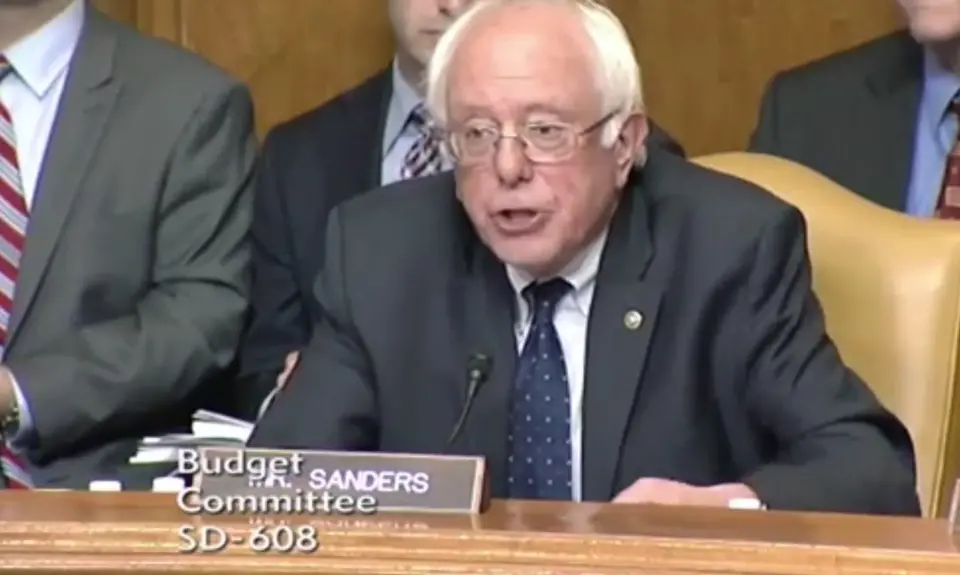
Last week, a day before James Comey’s congressional testimony transfixed politically minded Americans, President Donald Trump’s nominee to be deputy director of the Office of Management and Budget, Russell Vought, appeared in a much lower-profile confirmation hearing before the Senate Budget Committee. The hearing generated unexpected controversy over a line of questioning from Sen. Bernie Sanders (D-Vt.) who, in challenging what he saw as religious bigotry expressed by Vought, implied that the nominee’s religious beliefs disqualified him from the position, a religious test that crosses a constitutional line.
Sanders grilled Russ Vought over a blog post Vought had written in January 2016 for a conservative website, The Resurgent. Vought was defending a move by his alma mater, Wheaton College, to fire a faculty member who had said Muslims and Christians “worship the same God.” Vought praised the conservative Christian school for preserving “theological clarity” about its Statement of Faith regarding the divinity of Jesus Christ and belief in Him as the sole means for achieving salvation.
Sanders was particularly disturbed by these lines in Vought’s post: “Muslims do not simply have a deficient theology. They do not know God because they have rejected Jesus Christ his Son, and they stand condemned.” (Vought followed those lines with references to a New Testament verse using the “condemned” language about those who do not believe in Jesus as the son of God.)
As Emma Green noted at the Atlantic, “Where Sanders saw Islamophobia and intolerance, Vought believed he was stating a basic principle of his belief as an evangelical Christian: that faith in Jesus is the only pathway to salvation.”
Sanders first asked Vought if he considered that statement Islamophobic and then asked repeatedly if Vought believes that Muslims, Jews, and other non-Christians are “condemned.” Sanders concluded by saying, “I would simply say, Mr. Chairman, that this nominee is really not someone who this country is supposed to be about.”
Sanders appeared to be declaring Vought unfit to serve based on his religious beliefs, something that violates the U.S. Constitution’s ban on a religious test for public office. It also runs afoul of several of People For the American Way’s “Twelve Rules for Mixing Religion and Politics”—including a rule against politicians using religion as a political club.
As far as I know, Vought has given no indication that his religious beliefs about salvation will have any bearing on the job he was nominated to do. What could have been a more legitimate line of questioning for Sanders would have been to ask whether Vought’s religious convictions would prevent him from doing his job in a way that does not discriminate against those who do not share his beliefs. To draw an analogy, it would be inappropriate to block a nominee whose church teaches that homosexuality is a sin; but it would be appropriate to ask that nominee for a commitment to upholding equal treatment of the law for LGBTQ people.
Melissa Rogers, who worked in President Obama’s Office of Faith-based and Neighborhood Partnerships, made this point on Twitter, saying that senators should ensure nominees will protect equal rights for people of all faiths and none, but should not oppose nominees based on their theological beliefs.
Vought seemed to try to address that point in one of his answers: “As a Christian, I believe that all individuals are made in the image of God and are worthy of dignity and respect regardless of their religious beliefs. I believe that as a Christian that’s how I should treat all individuals…”
It is true that Islamophobia is a major problem in our political culture, and that harassment and intimidation of religious minorities and immigrants has spiked since Trump’s campaign and election encouraged people to express their bigotries more openly. Some Religious Right activists have gone so far as to claim that Islam is not really a religion and therefore that American Muslims are not covered by the First Amendment’s religious freedom protections.
People For the American Way strongly opposes religious bigotry and advocates for the fundamental constitutional principle that no person’s rights or opportunities should be restricted based on their religious beliefs. That applies to conservative Christians the same as it applies to Muslims, people of other faiths, and people who are religiously unaffiliated.
Sanders’ questioning of Vought has drawn plenty of criticism over the past week. But some of his critics, like Southern Baptist official Russell Moore, have also gone too far by claiming that “all Christians of every age have insisted that faith in Jesus Christ is the only pathway to salvation.” In fact, Christians and people of other faiths hold a spectrum of beliefs about the nature of the divine, the meaning of scripture, and pathways to salvation. It’s worth remembering that some right-wing activists accused President Barack Obama of being a secret Muslim and therefore, in their eyes, unfit to be president, while other Religious Right figures like Glenn Beck and David Barton savaged then-President Obama for holding what Beck deemed “evil” and even “satanic” beliefs about salvation.
A statement from a Sanders spokesperson said in part, “In a democratic society, founded on the principle of religious freedom, we can all disagree over issues, but racism and bigotry—condemning an entire group of people because of their faith—cannot be part of any public policy.” But there was no indication that Vought’s religious beliefs would influence public policy, and that was not part of Sanders’ line of questioning.
Avoiding such confusion is one reason that public officials in a pluralistic society should avoid declaring the superiority of their religion or denigrating the faith of others. Americans hold many religious beliefs but should be united in our commitment to the Constitution.