


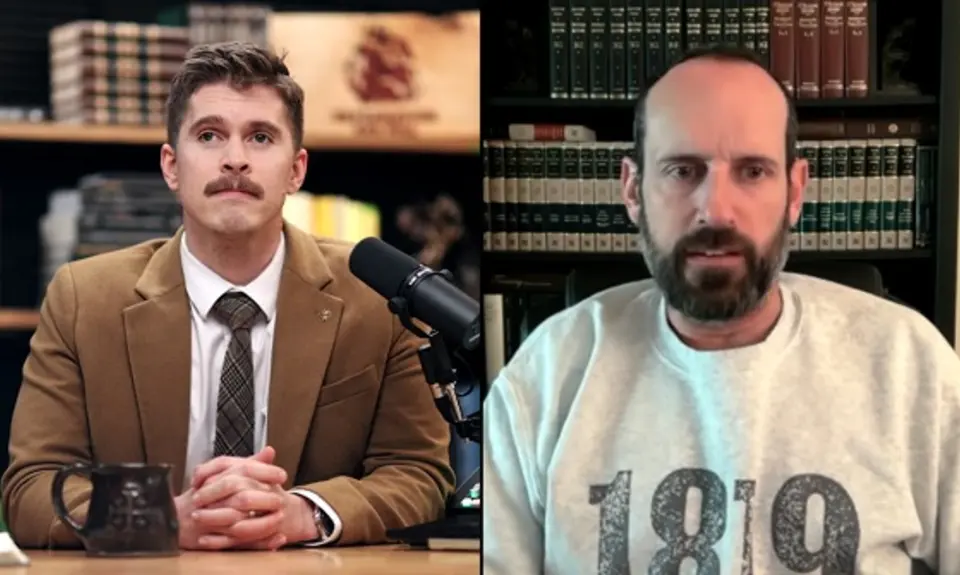
Last week, Christian nationalists Joshua Haymes and Brooks Potteiger urged their fellow right-wing Christians to pray "imprecatory psalms" against James Talarico, the Democratic nominee for the U.S. Senate from Texas.
Talarico is a Presbyterian seminarian who has openly cited his Christian faith in support of his progressive political positions, much to the outrage right-wing Christian nationalists.
Potteiger, who was the pastor at the church attended by Secretary of Defense Pete Hegseth in Nashville, Tennessee, and will soon take over the Washington, DC church founded by Christian nationalist Doug Wilson, warned that Talarico is "a wolf" who is working to "distort what Christianity is in order to lead people away from Christ, toward the teaching of demons."
As such, Potteiger and Haymes encouraged the use of "imprecatory psalms" against Talarico, which are prayers asking God to pour out his destruction upon one's enemies.
"I pray that God kills him," Haymes declared. "Ultimately, that means killing his heart and raising him up to new life in Christ ... If it would not be within God's will to do so, stop him by any means necessary."
Shortly thereafter, Haymes, a far-right podcaster and commentator, returned to the subject of calling upon God to destroy one's enemies on an episode of his "Reformation Red Pill" program featuring Pastor Rich Lusk of Trinity Presbyterian Church in Birmingham, Alabama. During the program, Lusk and Haymes agreed that there might be times when the law of God requires Christians to kill their political enemies.
"We are facing evil in our day that our grandparents didn't have to face," Haymes declared. "We are descending more and more into cultural chaos and we are seeing real rank idolatry and evil, child sacrifice, child mutilation. We are seeing such unbelievable wickedness that we need to be equipped with the Psalms, to pray and sing these. Our offensive weapon in this battle, in this spiritual war that we are in, is the sword of the spirit and we need to be able to wield it effectively."
Declaring that the use of imprecatory psalms against their political enemies is needed now more than ever, Haymes urged Christians to "pray that God would stop them by any means necessary."
"Stop the child sacrifice, stop the child mutilation, stop the sexual degeneracy that is leading our nation into degeneracy and chaos," Haymes proclaimed. "We should be eager, and I would say desperate, for God to stop this by any means necessary."
Lusk and Haymes went on to explain that Jesus' call to love your enemy only means that Christians should be kind to others on a personal level.
"In my daily interactions with this non-Christian person, I can be kind to them," Lusk said. "At the same time, I can want to see their worldview, their LGBTQ political movement completely and utterly destroyed. I can want both of those things at the same time. I can be kind to them at a personal level while wanting to see their worldview, their way of life, their political and cultural movement completely obliterated."
"There's a distinction to be made between private enemies or personal enemies," Haymes agreed. "You are called to love your personal enemies, those who you have personal grievances against, but that barbarian horde at the gate who wants to come in and rape and pillage and plunder and destroy you, your family and your civilization? You don't love them. You cry out to the Lord that he would bring judgment upon them, that he would stop them. Stop them, Lord, by any means necessary."
"I think ideologies like the alphabet cult ideology or even like mass immigration, leftist ideology, egalitarianism, feminism, all of these ugly isms that are destroying our society; those are equivalent to the barbarian horde," Haymes continued. "Those who have been sucked into that ideology and promote those ideologies and pursue them in our current cultural climate, in our context, those are enemies. Those are public enemies who have made themselves enemies of God, and enemies of nature, enemies of the created order, and we want God to stop them."
"If my lesbian neighbor needs someone to help her change her tire, I want to be quick to be able to do that, while also saying everything that you stand for and that you pursue is evil and wicked, and I want it stopped," Haymes concluded. "I want it stopped by any means necessary."
Lusk took things a step further by noting that there might be times where Christians have to kill to protect their family or their nation from those intent on doing evil.
"There's a hierarchy to our love," Lusk said. "We're not supposed to love everybody in exactly the same way. I've got greater obligations and therefore a greater love towards, say, my family than I do someone who's outside of my family. I've got greater love for my own countrymen than I do people on the other side of the world."
"Let's say somebody breaks into my house and they're threatening to kill my family, maybe kidnap my children, rape my wife and daughters," Lusk continued. "in the moment, if you say, 'Well, do you love this person?' I can say, 'Well, he's an image-bearer. I can love him in some sense, but I love my family much more than I love him.' And so therefore, out of love for my family, I will kill him; I will kill this evil intruder who's threatening my family's life, the lives of my family members, I will kill him because I love my family more than I love him. I've got an obligation to protect my family, and in protecting them, that may mean that I have to end his life and send him to meet his maker."
"I don't have to say that I don't love him in any sense whatsoever," Lusk added. "I can say I do, but I love my own family so much more that I will defend my family and I will do what is necessary to defend my family. And if that means killing him, that means killing him."
"That's what the law of God requires—and you could certainly say allows, but I would also say even requires—in that kind of situation," Lusk concluded. "Even if you say we are to love our enemies—even our political or public enemies—there's still a sense in which we can say, 'Yeah, there are times where we have to kill someone we love out of self-defense or out of national defense because we love our people more.'"