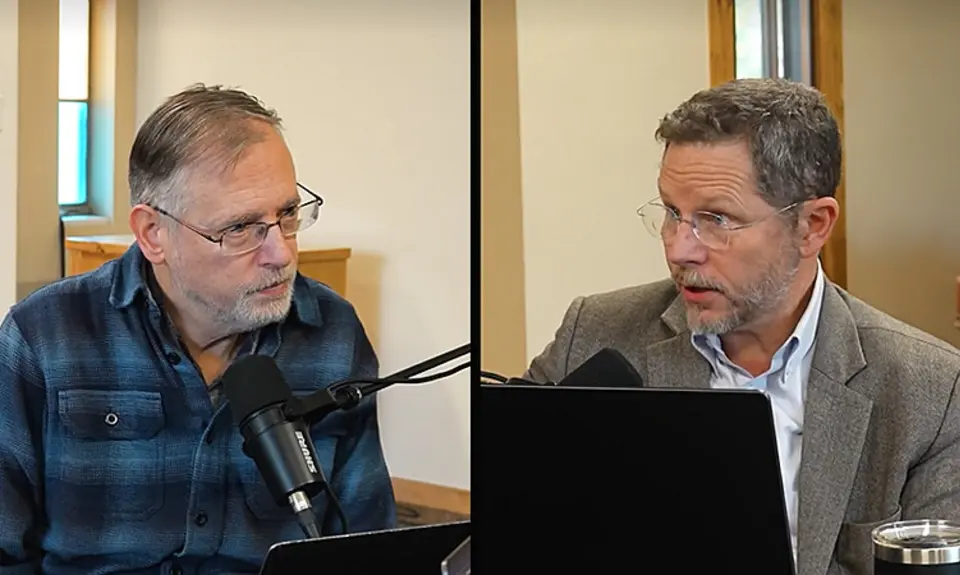
A pastor aligned with the hard-right Reformed theology of influential Christian nationalist Doug Wilson is promoting and pursuing a plan to fulfill the “dominion mandate” by moving like-minded people into sparsely populated rural counties, colonizing and discipling “Christian settlements,” and building miniature civilizations based on their religious worldview.
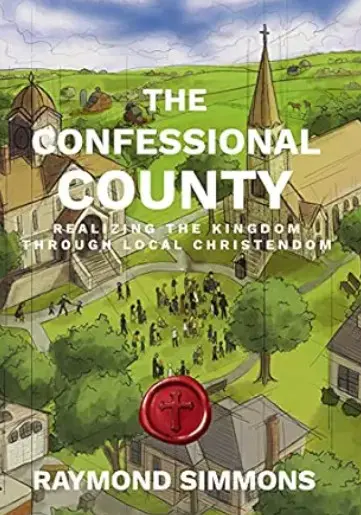
Raymond Simmons, a pastor and podcaster based in Red Oak, Iowa, is the author of “The Confessional County: Realizing the Kingdom through Local Christendom, which was published in 2021. Simmons talked about the book and his current colonizing project in a podcast interview posted on June 2 by Kevin Swanson, a promoter of Christian-right homeschooling curricula who spreads his ideas via a newsletter and radio show. Simmons promotes his own religious and political ideology at “The Confessionalists” website.
Here’s the basic idea behind Simmons’ plan: The U.S. is under a “land curse” from God because it has allowed abortion, sexual immorality, sabbath-breaking, and idolatry to go unpunished. The nation as a whole is not going to make sufficient repentance to get out from under the curse, but Christians can receive God’s blessing by carving out smaller societies that officially repent and commit themselves to living in accordance with God’s law.
“Spiritual warfare can be leveraged geographically,” Simmons writes. "Demons are not omnipresent and can be forced out of geographical areas through spiritual warfare.”
Quoting the late Christian Reconstructionist R. J. Rushdoony, Simmons told Swanson the best way to do that in the U.S. is at the county level, specifically in rural counties, where a small but committed group of people can shape the culture and elect county officials who share their worldview.
Simmons’ plan has some similarities with moves in Tennessee and elsewhere to create new conservative Christian communities. Simmons also makes reference to right-wing “Benedict Option” author Rod Dreher, who argues that Christians have so completely lost the culture war that they should focus on building their own communities. But Simmons argues that his own plan goes further in advancing Christendom.
Many of Simmons’ ideas about what a Christian society should look like are similar to those expressed by Pete Hegseth’s spiritual mentor Doug Wilson, who Simmons cites repeatedly. But there’s one big difference. In response to criticism of his extremist goals, Wilson has tried to allay people’s fears by suggesting that the patriarchal Protestant republic of his dreams might be centuries in the making. Simmons believes his vision can be achieved at the local level far sooner.
Simmons told Swanson that he and his church in Montgomery County, Iowa—“we are a church and a settlement”—are four years into their 20-year “war plan.” Simmons said, “I think we’re postured to accept a new batch of people moving in.”
The Plan: Colonizing Rural Counties
“According to the US Census Bureau, 97 percent of the country’s landmass is rural, but only 19.3 percent of the population lives there,” Simmons writes, creating an opportunity for Christian settlement. He refers admiringly to a Mennonite project of “Colonizing Rural America” and calls on people with Reformed theology to do the same.
Simmons, who is a military veteran, repeatedly refers to Confederate Gen. Stonewall Jackson’s strategy of the “oblique”—something other than a head-on attack. “Flanking maneuvers are usually done by a small unit, hopefully undetected until the strike,” he writes. “This book’s stratagems are best suited for a low population county without a strong culture.”
The idea that it’s easier to build a new culture in a place with few people and few strong existing institutions makes intuitive sense. Simmons spells it out:
You want to create culture, and you want to exercise the biblical doctrine of confessionalism. The confessional county is based on the idea that covenanting with Christ allows progress; it is not the result of progress. Indeed, small rural counties will still have a culture. However, if the culture is not strong and not immediately dangerous, you can essentially ignore it as you build another one alongside it that will eventually overtake it. The “offset” strategy we discussed, where you have the freedom to leapfrog competing forces by not directly fighting them, could be executed in rural counties in my estimation.
Simmons’ book gets practical, offering a set of conditions and characteristics of a county that might be successfully colonized into a “confessional county.” Among his criteria for an ideal settlement opportunity:
- Good (i.e. lax) homeschool laws
- A state with home rule but not Dillon Rule (which gives states authority to limit local powers)
- High land freedom: low taxes, few and lightly enforced zoning restrictions and building codes
- Rural with population under 10,000 that has a small town but is not growing via transplants or part of a larger city’s urban sprawl
- Within daily driving distance of the state capital
- No major college or university since they are “a primary source of pluralism and anti-Christian philosophy"
- No well-respected “government schools” or county welfare and housing programs
- No national retail chains that would fight sabbath laws
- No state or federal agencies that employ more than a few people
- No rich “God-hating families”
Phase I: How to Get Started
Once a group of would-be civilization-builders has found and purchased land, recruited an initial group of families to participate in the settlement, and established a place for worship, it’s ready to get going:
Worship, prayer, and evangelism should start right away. Spiritual warfare should happen early and often. Satan won’t like your approach. Since the idea of the confessional county is to tap into Christ’s power at the outset, a covenant should be made with the representative heads of the church, heads of families and any willing Christian local magistrate as soon as possible. This will not be the all-of-society we have seen in the biblical examples, but you can call out to God for at least temporary suspension of curses.
Priorities for this first phase are to grow the church in unity, purity, and numbers; establish businesses; create ways to establish a culture; and select and groom men for local office. He suggests this phase might take about 10 years.
At the culmination of Phase I, you should be ready for your county to perform social confessionalism. You will have won the respect of the locals. You will have spent a decade teaching and preaching the doctrines of grace and covenant theology. You will have been evangelizing, and you will have been creating a culture of beauty and righteousness. You will have been praying fervently for a decade, casting demons out of the land. Timing is ultimately up to God, but if He is gracious, there will be cultural progress. You will have been trying to root out pluralism. Perhaps by this point, there are only Bible-believing churches in the county. If not, keep praying, preaching, and teaching.
Simmons’ book offers several examples of suggested language that could be used for social confessions, either officially adopted county resolutions or unofficial declarations by religious and civic leaders. Here are the general guidelines:
A church leader should bring the Word, and there should be representative heads from the churches, the civil magistrate, and the families in the community. Representatives should confess the sins of the land and covenant with Christ as a society. The covenant should be read and signed. In a sense, you are separating yourselves from the sins of the nation by committing the county to Christ.
The ‘Confessional’ Agenda
“If we deny that Christ is the rightful Lord of the state as well as the church, our ruin is moral, religious, political and social,” according to Simmons. He says it’s important to vet new recruits and understand whether they are motivated by “love for the crown rights of King Jesus.”
Repentance and covenanting—not just individually, but socially—is the foundation of Simmons’s plan for the creation of local Christendom. Repentance must be made, and a written covenant recognizing Christ’s Lordship over society and government must be declared and signed, ideally by a combination of religious, business, and civic leaders. Getting a county to that point could take a decade of preaching, building influence in local culture, and putting people in positions of power; religious leaders could make a public covenant sooner as a first step to inviting God’s blessing on the community.
Simmons considers the idea of human autonomy to be a core cultural problem, and his book reveals just how drastically autonomy and individual freedom would be restricted in societies built on his vision of Christendom.
Here are some quotes from the book’s suggested language for social confessions, with citations to Bible passages removed:
- Only Christian men in good standing in an evangelical church are qualified to hold public office. We repent of electing and supporting men who are not qualified according to Your standards. We repent of electing and supporting women to civil offices.
- The Christian faith is a public faith and makes claims upon all areas of life. We repent of laws and interpretations of laws that contravene Your command for us to proclaim Your name throughout the land. We repent of not calling men to repent and to obey the gospel.
- Abortion is murder and therefore breaks the Sixth Commandment and is a capital crime. We repent of any abortion in our country, state, and county. We repent of not punishing abortion according to Your law, and we ask that You heal our county and forgive us. We resolve that no abortion will be allowed to take place in our county. Please help us.
- Homosexuality is listed in multiple areas of the Bible as being a capital crime. We repent for allowing deliberate, public, unrepentant homosexuality in our nation, state, and county. Please heal the land of our county and forgive us.
- Adultery is a capital crime, and our failure to punish this crime has defiled the land. We repent of this sin and our lack of punishing it. Please, Lord, heal the land of our county and forgive us.
In small conservative rural counties it’s not hard for an organized group to sway elections for positions like county commissioner, sheriff, or auditor, says Simmons. He writes that in his county, with a population of just over 10,000, people can carry county elections with fewer than 400 votes in a GOP primary.
When the right kind of people take political power, they can move to the next phase and begin to eliminate unbiblical property taxes, “government schools,” “government housing,” and “unbiblical funding of social programs.” Those are jobs for civil magistrates, but other goals are left to families and “general culture,” like the need to “make it undesirable for homosexuals to move in and defile the land.”
Simmons recognizes that federal and state constitutions and laws may interfere with the goal of “comprehensiveness”—all of society embracing and enforcing all the requirements of scripture—which he says highlights the importance of having a like-minded county sheriff making decisions about which laws to enforce and how.
Here Simmons’ “confessional county” strategy aligns with the right-wing “constitutional sheriff” movement, which argues that a county sheriff’s primary responsibility is to protect his constituents’ freedom from tyrannical overreach by federal and state officials, and which has encouraged county officials to declare themselves “constitutional counties.”
Simmons also cites anti-abortion extremist Matthew Trewhella’s writing on the doctrine of the lesser magistrates, which declares that it is the responsibility of local officials to “interpose” themselves between citizens and tyrannical federal officials.
The ‘Problem’ of Pluralism
Freedom of religion and religious pluralism are defining characteristics of the United States, guaranteed by the First Amendment to the Constitution. But Simmons argues that pluralism is a core structural problem:
The US slowly developed into a pluralistic state with autonomous laws. But that is the wrong structure. The structure we really need is comprehensive Christianity. We need everything built upon Jesus Christ and His law. Therefore we don’t just need a reboot; we need a whole new operating system.
“Pluralism is the idea that mutual worldviews and life systems can exists side by side,” Simmons writes, calling it “the root of an unrighteous society.” Like Wilson, Simmons argues that allowing the public practice of different religions is “unbiblical.”
Simmons asserts that the “public practice of unbiblical religion (which today would be mosques, Buddhist temples, Roman Catholic churches, etc.) is idolatry and puts the city under God’s condemnation. Pluralism (which results in publicly-practiced idolatry) must be removed for God to approve a geographical area for blessings.”
“Pluralism is polytheism and therefore idolatry,” Simmons writes. “Any religion other than Christianity is idolatry…The Lord owns all the earth, so idolatry is not allowed anywhere.” He cites Reconstructionist Gary North in arguing “the folly of thinking we can ever hope to receive societal blessings in a pluralistic society.”
The inclusion of Catholicism as an unbiblical and idolatrous religion highlights the fact that when Simmons talks about Christianity, he only means Christianity as practiced on his terms. When describing the benefits of settling rural counties and small towns, he writes, “Even if a small town does have a single Roman Catholic church (most have one), it will be easier to get rid of than multiple ones in a city (plus all the mosques, etc.)”
Why it Matters: The Christian Nationalist Threat to Freedom and Democracy
Whether or not Ray Simmons’ project to turn his Iowa county into a “confessional county” is successful, his effort reflects the threat that increasingly aggressive white Christian nationalism poses to personal freedom, religious liberty, peaceful pluralism, and democracy itself.
The hard-right Reformed theology embraced by Simmons and people like Doug Wilson is just one aspect of the threat that right-wing Christian nationalism poses in the U.S.
The fundamentalist Southern Baptist Convention, the nation’s largest Protestant denomination and once a defender of church-state separation, has recently continued its long rightward shift with the election of new leadership by forces who decried a supposed drift toward “wokeness” within the denomination. Its new leadership is backed by MAGA Christian nationalist William Wolfe.
In addition, the dominionist religious and political ideology promoted by the Pentecostal New Apostolic Reformation movement and its apostles and prophets has gained unprecedented influence during the Trump era. The language of Seven Mountains Dominionism has been adopted across the religious right as a means of mobilizing conservative Christians to greater political engagement.
Democratic values are also threatened by “integralist” and “post-liberal” Catholic intellectuals who have given up on democracy, the secretive power-building of the far-right Catholic group Opus Dei, and the massively funded dark-money networks overseen by Leonard Leo, which played a major role in bringing us the reactionary Supreme Court majority that overturned Roe v. Wade, empowered Trump’s lawbreaking with an invented doctrine of presidential immunity, and has systematically dismantled the protections of the Voting Rights Act.
While these movements are grounded in conservative forms of Christianity that differ theologically in significant ways, they have often set aside those differences to work in concert and in parallel to oppose legal access to abortion, reject feminism, resist legal protections for LGBTQ+ people, disparage and undermine the principle of church-state separation, and elect right-wing politicians, including President Donald Trump.
Americans who treasure the freedoms protected by the Constitution and the separation of church and state must meet the threats posed by Christian nationalist and dominionist movements with public affirmations of our commitment to our First Amendment freedoms, religious pluralism, and the democratic values of individual liberty and equality under law. And we must organize to elect at every level political leaders who will defend those values when they are under attack.