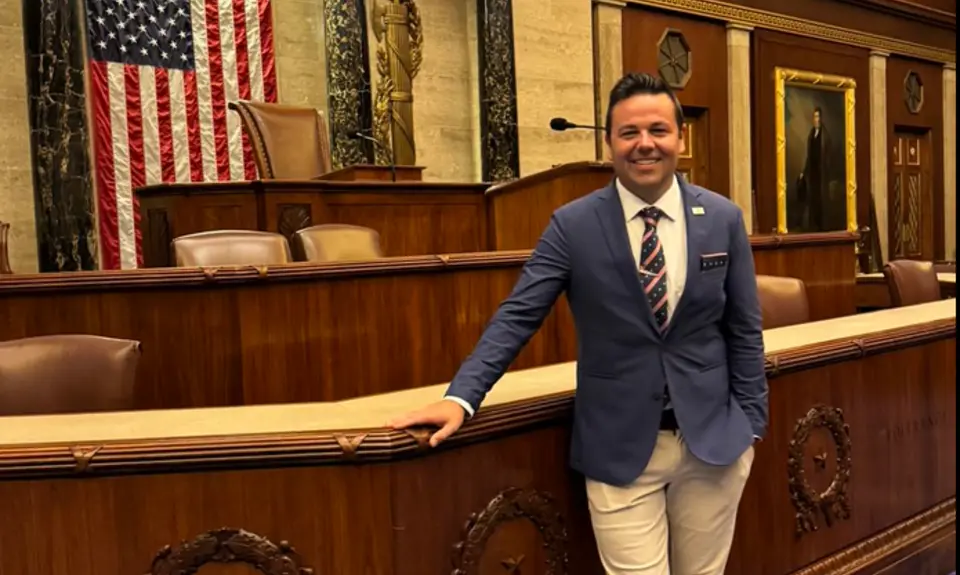
Since taking office in 2024, Indiana’s far-right Christian nationalist Lt. Gov. Micah Beckwith has repeatedly used his position to spread baseless claims about the nation and its founding. This tendency was on display last week when Beckwith spoke at a TPUSA "Pick Up The Mic" event held at Purdue University Northwest.
During his remarks, Beckwith claimed that the doctrine of the separation of church and state was something concocted by Supreme Court Justice Hugo Black in the 1940s because he did not like that Catholics were criticizing the Ku Klux Klan.
"How many people have heard that phrase before, separation of church and state?" Beckwith asked the audience. "Everybody. It's amazing. Do you know it's not anywhere in our founding documents? You can't find it. People say, 'The First Amendment.' No, it's not in the First Amendment; it does not say separation of church and state."
"That came from a letter that [Thomas] Jefferson wrote to the Danbury Baptist Association in 1802 as he was president because they were afraid the government was going to tell him what to preach," Beckwith continued. "And he said, 'No, the government's not coming into your church. We have a wall of separation of church and state.'"
"That got warped in the 1940s by a Supreme Court justice," Beckwith said. "His name was Hugo Black. There's a case that came before the Supreme Court. Hugo Black was a KKK member. He hated blacks and he hated Catholics and he did not like that Catholics were starting to stand up and say, 'What the KKK is doing to the blacks is not godly.' So he found a way in this case—he pulled this letter that was not a founding document, it was a private letter.—he says, 'Hey, Thomas Jefferson said separation of church and state; we should make this the standard so that all churches stay out of government policy,' which is the opposite of what actually Jefferson was saying.
The doctrine of the separation of church and state, Beckwith concluded, was created out of whole cloth by "a Supreme Court justice who was a KKK sympathizer and member who wanted to get the church and godly people out of the way."
As usual, Beckwith's interpretation of events is wildly inaccurate.
While Black was a member of the KKK in the 1920s, he claimed to have resigned before he became a U.S. senator and eventually a Supreme Court justice.
It was in his capacity as a Supreme Court justice that Black authored the majority decision in Everson v. Board of Education of the Township of Ewing in 1947, which established that the First Amendment's prohibition on the establishment of religion applied to the states and popularized the notion of a separation of church and state.
But contrary to Beckwith's assertion, the case had nothing to do with Catholics or the KKK and the decision that Black wrote actually protected a state law that allowed public funds to be used to transport students to religious schools.
At issue was a New Jersey law that reimbursed parents whose children used public transportation to get to school, including religious schools. A lawsuit was filed arguing that allowing state funds to assist in transporting students to parochial schools amounted to state support of religion, but Black wrote the 5-4 decision ruling that the law was constitutional.
No tax in any amount, large or small, can be levied to support any religious activities or institutions, whatever they may be called, or whatever form they may adopt to teach or practice religion. Neither a state nor the Federal Government can, openly or secretly, participate in the affairs of any religious organizations or groups, and vice versa. In the words of Jefferson, the clause against establishment of religion by law was intended to erect "a wall of separation between church and State."
We must consider the New Jersey statute in accordance with the foregoing limitations imposed by the First Amendment. But we must not strike that state statute down if it is within the State's constitutional power, even though it approaches the verge of that power. New Jersey cannot, consistently with the "establishment of religion" clause of the First Amendment, contribute tax raised funds to the support of an institution which teaches the tenets and faith of any church. On the other hand, other language of the amendment commands that New Jersey cannot hamper its citizens in the free exercise of their own religion. Consequently, it cannot exclude individual Catholics, Lutherans, Mohammedans, Baptists, Jews, Methodists, Nonbelievers, Presbyterians, or the members of any other faith, because of their faith, or lack of it, from receiving the benefits of public welfare legislation. While we do not mean to intimate that a state could not provide transportation only to children attending public schools, we must be careful, in protecting the citizens of New Jersey against state-established churches, to be sure that we do not inadvertently prohibit New Jersey from extending its general state law benefits to all its citizens without regard to their religious belief.
Measured by these standards, we cannot say that the First Amendment prohibits New Jersey from spending tax-raised funds to pay the bus fares of parochial school pupils as a part of a general program under which it pays the fares of pupils attending public and other schools.
Given that Black penned the ruling allowing public funds to be used in the transportation of students to religious school, it is absurd for Beckwith to claim that Black wrote this decision to protect the KKK from Catholic criticism as part of some effort to ultimately "to get the church and godly people out of the way."