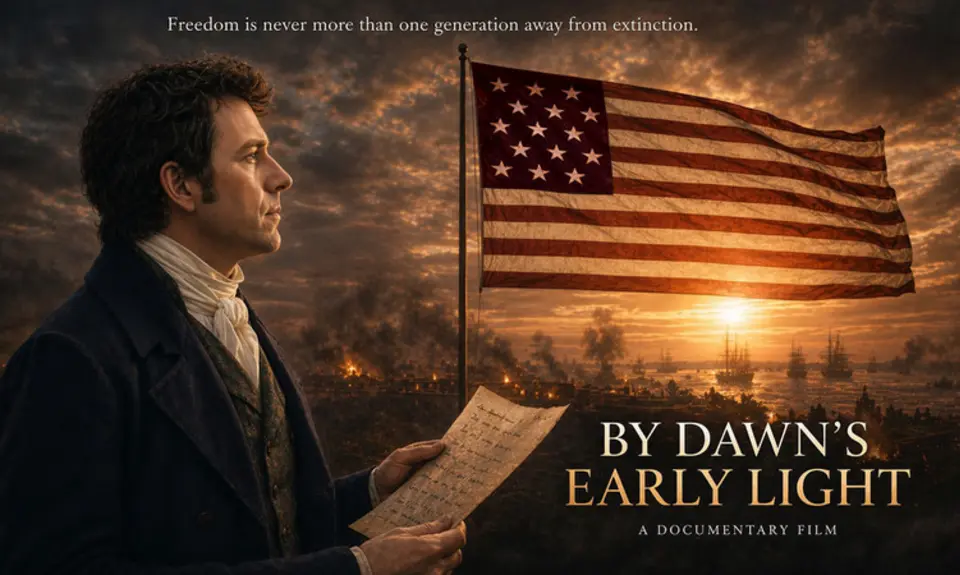
The Trump administration has partnered with its religious-right allies to produce and promote a propaganda “documentary” that promotes Christian nationalist ideology and portrays the Biden administration and the left in general as enemies of faith and freedom. It puts a Trump-era spin on the religious right’s longstanding strategy of claiming anti-Christian persecution as a way to mobilize its political supporters.
The film, “By Dawn’s Early Light,” is essentially a video version of the deeply flawed report released at the end of April by the administration’s Task Force to Eradicate Anti-Christian Bias. That report distorted U.S. and constitutional history to promote a privileged role in policy and law for a narrow category of Christians, according to Amanda Tyler, executive director of the Baptist Joint Committee for Religious Liberty.
The title of “By Dawn’s Early Light” is drawn from the Star-Spangled Banner, and the film regularly uses the War of 1812 as a metaphor for the supposedly existential threat to freedom faced by American Christians today. Americans won their freedom in the Revolutionary War but almost lost it all in the War of 1812, the narrator says, adding, “Likewise, modern America stands on the verge of losing everything we fought for, but this time the enemy is within.”
The film features current and former members of Trump’s cabinet, including Secretary of State Marco Rubio and former Attorney General Pam Bondi, right-wing members of Congress, and religious-right leaders and activists like Eric Metaxas.
It takes direct aim at the separation of church and state, which protects all Americans’ religious liberty. “People have come to believe in concepts that are foreign to our Constitution,” says the narrator, while video shows someone at a protest march holding a sign supporting church-state separation.
“Some people believe in separation of church and state, which is actually a phrase that Thomas Jefferson used in a letter in 1802. It’s nowhere in our Constitution, Bill of Rights, or Declaration of Independence,” says Gary Hamrick, a pastor and right-wing political activist.
Jeremy Dys of the religious-right legal group First Liberty adds, “I don’t think that phrase has the meaning many on the left ascribe to it today.” Both Rubio and religious-right activist William Federer imply that the First Amendment was simply meant to prevent the federal government from choosing one Christian denomination over another.
Over images of the Supreme Court, the narrator intones, “So, when leaders expel God, and replace him with government, religious liberties begin to disappear.”
The film then pivots to its main purpose, which is portraying the Biden Administration as an enemy of faith and freedom.
“During the Biden administration, every single liberty, every single right we have under the First Amendment was assaulted,” says Rep. Jim Jordan, a zealous defender of the Trump administration. Similarly, Steve Crampton of the right-wing Catholic Thomas More Society, claims the rule of law was “shattered” under the Biden administration. Has he seen Trump in action?
“It was as if there was an onslaught against Christians just for being a Christian,” claimed Christina Compagnone from the American Center for Law and Justice, one of a vast and massively funded network of Christian-right legal and political groups that somehow survived the “onslaught.”
Secretary of Defense Pete Hegseth, possibly the most aggressive Christian nationalist in the administration, declares, “When you have anti-Christian bias, you’re suppressing the entire foundation, the premise of the United States of America.”
Treasury Secretary Scott Bessent promotes a right-wing narrative about “debanking” and made the wildly overblown claim that during the Biden administration, “If someone had very strong Christian beliefs, whether on TV, in the pulpit, to their congregations, they were debanked.”
The movie recycles other manufactured outrages, such as the widespread false claim by religious-right activists that then-President Biden had deliberately declared Easter Sunday as Transgender Day of Visibility as a direct insult to Christians. In fact, Transgender Day of Visibility has been commemorated every year on March 31 since 2010; in 2024, that date happened to coincide with Easter, which gave religious-right activists a chance to pounce when Biden issued a proclamation recognizing the day. (Biden also released a statement recognizing Easter and hosted an Easter event at the White House.)
“By Dawn’s Early Light” doesn’t let the facts get in the way of an outrage narrative. Sen. James Lankford recalled the moment as an “overt” decision to “poke people of faith.” HUD Secretary Scott Turner called it a “slap in the face of Christians across our nation.”
The film similarly overstates the facts around the “Richmond memo,” an internal assessment prepared by the FBI’s field office in Richmond, Virginia, after the arrest of a Virginia resident who described himself as a “radical traditional Catholic Clerical Fascist,” who, as the New York Times reported, “illegally collected weapons, had a history of making violent threats against liberals, racial minorities and Jews, and seemed to be preparing to launch some kind of domestic terrorist attack.”
When the memo was leaked identifying radical traditionalist Catholics as a possible threat, Rep. Jordan and other right-wing figures worked hard to claim it was evidence that the administration was targeting conservative Catholics. But the memo was withdrawn by FBI leaders, and the Justice Department’s Inspector General found no evidence of malice or anyone being directed to investigate Catholics because of their faith. But Jordan claims in “By Dawn’s Early Light” that “If you are a pro-life Catholic, they thought you were an extremist.”
The film also targets the Johnson Amendment, which prevents tax-exempt nonprofits, including churches, from directly engaging in electoral politics. Trump’s promise to do away with the 1954 Johnson Amendment, which the film calls “one of the most insidious attacks” on religious liberty, was part of the deal he offered religious-right leaders in order to get their support in 2016.
In a segment about the Johnson Amendment supposedly muzzling churches, Hamrick complains that the Justice Department fined him for a 2020 pre-election sermon. He disingenuously claims in the film that his sermon did not endorse Trump, saying, “All I was doing was preaching about the issues.” In reality, it was an intensely partisan sermon that told people to “get over” their qualms about Trump because the country was at “war” against an “evil” progressive agenda. The sermon was promoted by Paula White’s One Voice Prayer Movement and other religious-right groups in a last-minute push to turn out conservative Christian voters for Trump.
Other familiar territory covered by the film includes objections to the enforcement of vaccine requirements during the COVID-19 pandemic; claims that “anti-Christian bias has increased exponentially” in education; the arrest of prosecution of protesters blocking access to abortion clinics; and complaints about anti-discrimination policies being applied to foster care programs. In one particularly alarmist claim made the Alliance Defending Freedom’s Kristin Waggoner, she said that if the government is able to prevent people from being able to foster or adopt based on an unwillingness to abide by policies requiring support for LGBTQ+ children, “the natural assumption and next place that the government will go is that you’re also unable to raise your biological children.”
The film then turns to pro-Trump propagandizing, portraying his anti-bias task force and the White House Faith Office as part of the administration’s defense of religious freedom, with numerous cabinet members touting policy changes under their leadership.
Hegseth, who hosts proselytizing evangelical worship services in the Pentagon led by Christian nationalist extremists, bragged that under his leadership, commanders and chaplains can pray “not some mealy-mouthed agnostic prayer about nothing, to the Earth, you can actually pray in the name of Jesus.”
The film returns repeatedly to its War of 1812 metaphor, saying at one point, “Similar to the War of 1812, the survival of our liberty is at risk. Because in recent years the foundations of our religious freedom have been under serious attack.”
The film became available online on May 31 and is being promoted by Salem Media and religious-right groups. On a call last week, the White House Faith Office said that it had invited 1000 religious leaders to a May 18 premiere at the Kennedy Center.