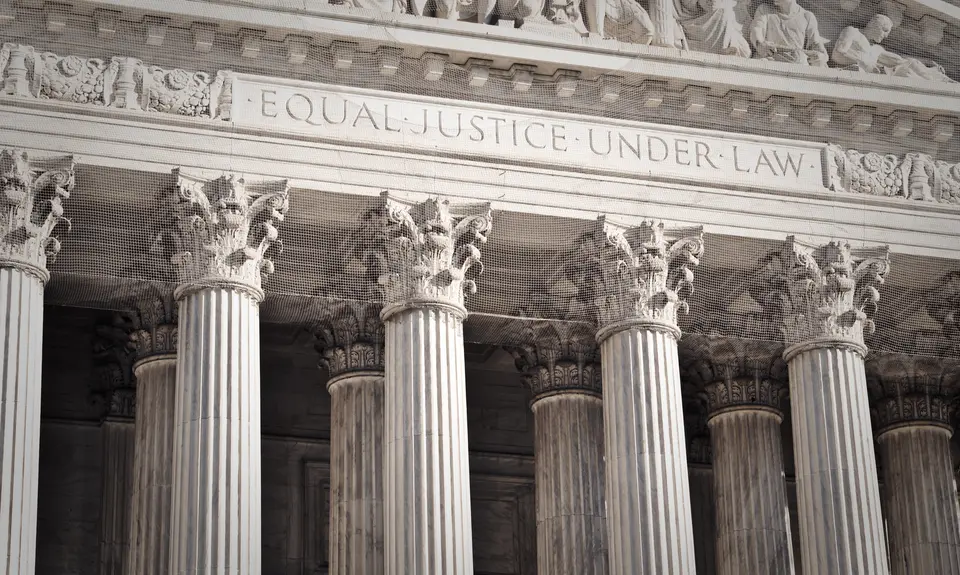
The Supreme Court held oral arguments today in the birthright citizenship case, Trump v. Barbara. The justices are considering whether to uphold Donald Trump’s lawless effort to eliminate the Fourteenth Amendment’s protection of citizenship for people born in the United States.
What did Trump do?
On his first day back in office in 2025, Trump issued an executive order declaring that people born after February 19 in the U.S. to undocumented immigrants are not American citizens. If allowed to go into effect, this would strip about 200,000 babies every year of U.S. citizenship.
What does the Constitution say about citizenship?
After the Civil War, the Fourteenth Amendment became part of our Constitution. The amendment begins:
All persons born or naturalized in the United States, and subject to the jurisdiction thereof, are citizens of the United States and of the State wherein they reside.
This did more than correct the infamous Dred Scott decision, which had held that Black people were not American citizens under the Constitution. The Fourteenth Amendment reflected an expansive concept of citizenship: Essentially, anyone born here is an American citizen. This is sometimes referred to as “birthright” citizenship.
Who does this apply to?
If there were any doubt as to whether the amendment means what it says, the Supreme Court cleared it up in 1896. The question was whether Wong Kim Ark, who was born in the U.S. to Chinese immigrants, was covered by the Fourteenth Amendment.
This was a time of intense anti-Chinese racism, often reflected in the law. One of those laws banned nearly all immigration from China. So when Wong Kim Ark was returning to the U.S. from a temporary visit to China, government officials considered him a Chinese citizen and barred him from reentering the country of his birth. He sued, claiming he was a U.S. citizen.
The Supreme Court agreed. In so doing, it rejected the idea that birthright citizenship was only applicable to African Americans. For the past 130 years, it has been understood as a bedrock constitutional concept that people born in the U.S. to immigrant parents are American citizens.
Donald Trump and his MAGA supporters may wish this were not so. They may want to wave a magic wand and take away citizenship from millions of Americans born here to undocumented immigrant parents. But that would be flat-out unconstitutional. As parents of children who would be affected by Trump’s policy have sued, every court to consider the question has agreed. This is not a difficult question.
So why is the Supreme Court hearing this case?
They shouldn’t be. The Fourteenth Amendment is clear. Supreme Court precedent is clear. Every lower court is in agreement, which is why the Trump administration appealed to the Supreme Court. Its position is so extreme and baseless that the justices should have simply released a one-sentence order affirming the lower court decisions.
But they didn’t. Instead, they decided to consider Trump’s arguments. That alone tells you this is no ordinary Supreme Court that can be counted on to protect certain basic foundations of our freedom.
After all, this is the same Court that rewrote a different part of the Fourteenth Amendment to let an insurrectionist become president. And they gave Trump immunity for illegal acts as president, including trying to steal a presidential election and end American democracy.
So we can’t take anything for granted.
What happened during oral arguments?
Unfortunately, the conservative justices seemed to take the administration’s arguments more seriously than they should have. However – with the caveat that it’s hard to make predictions based on oral arguments – most observers seemed to agree that the administration will fail to win a majority.
Some highlights:
- Justice Alito injected his personal policy preferences into the arguments by criticizing previous administrations for “unenthusiastically” enforcing immigration laws.
- Chief Justice Roberts called part of the administration’s reasoning “quirky.”
- In response to the administration lawyer’s comment that it’s a “new world” since the 1860s because modern transportation technology makes what it calls “birth tourism” possible, Roberts replied, “It’s a new world, but it’s the same Constitution.”
- Justice Barrett pressed the administration on how it would determine the citizenship of “foundlings,” or babies born here but whose parentage is unknown.
- Justice Jackson asked if parents would be required to prove their legal presence at the time their children are born in order to prevent those children from being denied their rights as citizens.
- Justice Sotomayor pressed the administration on its claim that the redefinition of citizenship would only apply to babies born after the executive order. She pointed out that under the administration’s reasoning, nothing would stop it from applying the new rule to everyone, including people whose citizenship has never before been questioned.
A decision is expected toward the end of the Court’s term in late June or early July.