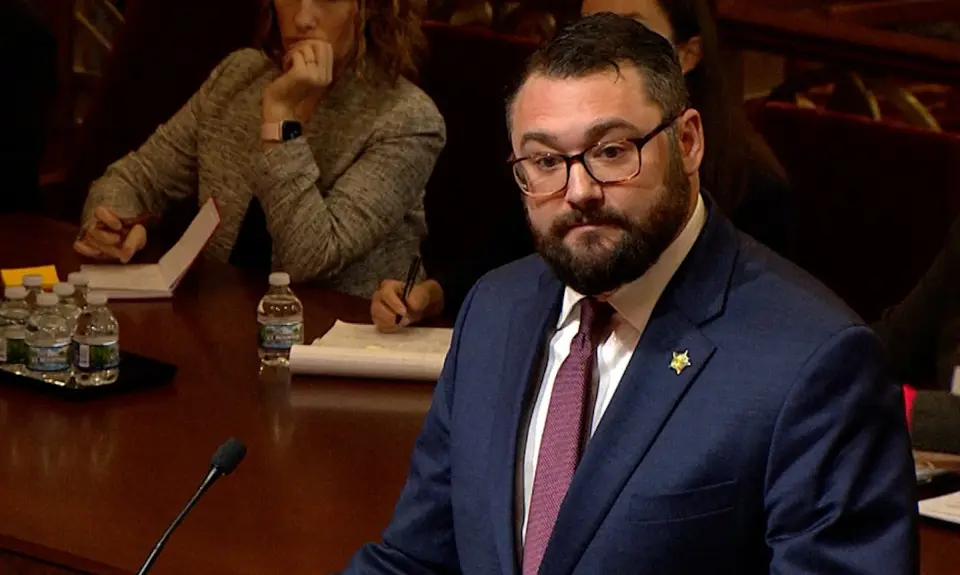
On behalf of our hundreds of thousands of supporters and activists nationwide, People For the American Way opposes the nomination of Benjamin Flowers to be a judge on the U.S. Court of Appeals for the Sixth Circuit.
As explained in more detail in the second half of this letter, we do not support confirming any judicial nominees of Donald Trump. He is dangerously unqualified to be making lifetime appointments to the one branch of government that is in a position to provide checks and balances to his lawless actions.
But first, this letter focuses on one of those nominees: Benjamin Flowers. His record of harmful extremism disqualifies him from a lifetime position on the Sixth Circuit.
Benjamin Flowers
Flowers proclaims himself a textualist and states that judges should be textualists. However, while many who defend that approach present it as a neutral way to interpret the law, Flowers has made its true purpose clear. In a 2025 Substack post, he wrote:
Timid textualism is not useful for those who wish to reverse, not just stop, the degradation of America's constitutional order and traditional Western values. Timid textualism will not, to borrow a phrase, Make America Great Again.[i]
“Make American Great Again” is, of course, the slogan used by Donald Trump and the Republican Party. It is unmistakably partisan. It is tied to achieving specific policy goals. An individual who links how a judge should decide cases to a results-focused political agenda is not someone who should be a judge. It is impossible to imagine litigants who do not share the MAGA agenda or who might be the targets of that agenda being confident that a Judge Flowers would decide their cases fairly, based purely on the law and without prejudice.
Judges are supposed to interpret the Constitution and statutes without regard to their political beliefs and personal values. But Flowers believes judges should rule in order to advance “traditional Western values.” His career as an attorney and those he has chosen to represent give some idea what he means by the phrase.
These “traditional western values” would take us back to a time when LGBTQ people were cruelly excluded from mainstream society. He opposed the right of transgender students to use the restroom consistent with their gender identity in an Ohio school district.[ii] He also filed an amicus brief in Ohio defending the constitutionality of the state’s law banning gender-affirming medical care for transgender youth. In a chilling statement showing what is at best a contemptuous refusal to understand the reality of trans people’s experiences, he wrote that “future generations will, one hopes, view this disturbing chapter of medical history the way that ours views the eugenics movement.”[iii]
These traditional values would also take us back to a time when, as at the nation’s founding, a large portion of the nation’s population was denied equality and citizenship. Flowers believes that the Constitution does not give citizenship to children born here to undocumented immigrants.[iv] That radical position would take our nation backward to before the adoption of the Fourteenth Amendment. That position can’t be separated from today’s political reality: Around the country, members of immigrant communities are hiding in their homes in terror of being grabbed off the streets by masked men acting on behalf of Donald Trump. Flowers’ position could make even more people subject to that terror.
These traditional values would be those embodied in our country in the 1950s or even earlier, when Black Americans’ constitutional right to vote crumbled before the reality of schemes to deny them any meaningful political power. Last year, Flowers filed an amicus brief with the Supreme Court urging it to overturn a vital precedent making it harder to redistrict in a way that dilutes the voting power of racial minorities.[v] The precedent he targeted was Thornburg v. Gingles, the landmark 1986 case that for the next 40 years helped courts determine when a redistricting plan has a racially discriminatory effect. (After he filed his brief, the Court issued its devastating decision in Louisiana v. Callais, overturning Gingles in all but name.)
These traditional values would be those from before the New Deal. For many years, an important far-right objective has been to dismantle the New Deal’s social safety net. They have worked to fill the courts with judges whose legal views would strip us of the power to effectively use the government to provide for us in old age, protect our health, bargain with our employers, have safe air and water, and much more.[vi] Flowers has called for judges to use textualism to impose a clearly political goal:
Textualism is necessary to good judging, but it is not close to sufficient; a Court that “correctly” decides cases on narrow grounds, without upsetting long-set but badly flawed precedents, will not be much use in restoring the constitutional order. That is unacceptable for the conservative movement of today, which seeks to reverse, not just arrest, our national decline; a movement that wants to kneecap the administrative state will not be satisfied with a Court content merely to erect some hurdles.[vii]
Flowers has also staked out positions that are particularly acute now, when the Trump administration has repeatedly acted to remove the guardrails protecting our democracy from becoming an autocracy. One of those guardrails is the judiciary and its ability to serve as a check on the power of an overweening executive branch. But Flowers has stated that “in the age of Trump,” the president can simply ignore large portions of judicial decisions he disagrees with.
Flowers concedes that Trump has to follow a specific order about litigants in a specific case. But when a court provides the legal reasoning for its decision to guide people going forward – an essential part of the rule of law – the president need not follow that if he disagrees with it. In a 2025 speech to the Toledo Bar Association, he said:
[W]hile the President must abide by the court-issued judgments, he may refuse to abide by the reasoning in opinions accompanying those judgments when the reasoning is contrary to the law. Indeed, he is constitutionally obligated to disregard flawed reasoning that, if followed, would cause him to violate the Constitution.[viii]
As an example, he specifically praises Trump for firing agency heads in violation of the nearly century-old precedent of Humphrey’s Executor.[ix]
Flowers would be a dangerous choice to serve as a lifetime federal judge on the powerful Sixth Circuit Court of Appeals.
The Senate Should Not Confirm Judicial Nominees of a President Who Defies the Courts and Expects Absolute Loyalty From His Nominees
The federal courts are essential to providing the checks and balances needed to prevent tyranny. At present, they are the only branch of the federal government carrying out this essential function.
President Trump does not share that vision of the courts. He expects the judges he nominates to show him personal loyalty and always rule in his favor.
This has been clear for a long time. However, on May 10, Trump himself made it impossible to pretend otherwise. In a Truth Social post, he wrote this about Supreme Court justices:
[I]t’s really OK for them to be loyal to the person that appointed them to 'almost' the highest position in the land, that is, a Justice of the United States Supreme Court.[x]
In March, condemned the Court for striking down his tariffs even though he supported them:
The Court knew where I stood, how badly I wanted this Victory for our Country, and instead decided to, potentially, give away Trillions of Dollars to Countries and Companies who have been taking advantage of the United States for decades.[xi]
He then went on to condemn the independence of justices who have ruled against him:
They openly disrespect the Presidents who nominate them to the highest position in the Land, a Justice of the United States Supreme Court, and go out of their way, with bad and wrongful rulings and intentions, to prove how "honest," "independent," and "legitimate" they are.[xii]
No president who is looking for unfettered loyalty from his judicial nominations can be allowed to put more judges on the bench at any level.
This development does not come out of the blue. Soon after returning to office, Trump began defying court orders and threatening judges who rule against him. In a May 30, 2025, letter to the Judiciary Committee, we explained that a president who does this should not be allowed to name anyone to the one branch of the federal government that is checking his power.[xiii]
Events since then have only strengthened our case. For instance, an extensively-documented whistleblower complaint revealed that senior Justice Department official Emil Bove suggested in March that the administration violate court orders.[xiv] President Trump subsequently nominated Bove to a seat on the Third Circuit, to which he was confirmed. The administration now routinely defies the courts. In fact, a July study revealed that the Trump administration had defied one in three judges who had ruled against him.[xv]
Nationwide concern over the Trump administration’s deceptive filings and court defiance continues to grow. The administration even risks losing the “presumption of regularity,” in which judges presume that the federal government and its lawyers are telling the truth and acting in good faith.[xvi] Indeed, an October 2025 report revealed dozens of instances of judges expressing distrust in the government’s representations, as well as growing concerns within the federal bench about noncompliance with judicial orders.[xvii]
And in November 2025, a sitting federal judge nominated by President Reagan resigned from his lifetime position in order to speak frankly and in depth about Trump’s threat to the rule of law. Mark L. Wolf wrote:
I no longer can bear to be restrained by what judges can say publicly or do outside the courtroom. President Donald Trump is using the law for partisan purposes, targeting his adversaries while sparing his friends and donors from investigation, prosecution, and possible punishment. This is contrary to everything that I have stood for in my more than 50 years in the Department of Justice and on the bench. The White House’s assault on the rule of law is so deeply disturbing to me that I feel compelled to speak out. Silence, for me, is now intolerable.[xviii]
Later that same month, President Trump even called for the execution of members of Congress for stating the undisputed legal fact that members of the military may not follow unlawful orders.[xix]
In January 2026 alone, the Trump administration violated nearly 100 court orders relating to ICE’s reign of terror in the Minneapolis area that led to brutal killings of American citizens Alex Pretti and Renee Good. These orders were issued to protect the people of Minnesota from unlawful abuses of power by ICE. On January 28, Chief Judge Patrick Schiltz released a list of those violated orders.[xx] He wrote:
[It] identifies 96 court orders that ICE has violated in 74 cases. The extent of ICE’s noncompliance is almost certainly substantially understated. This list is confined to orders issued since January 1, 2026, and the list was hurriedly compiled by extraordinarily busy judges. Undoubtedly, mistakes were made, and orders that should have appeared on this list were omitted.
This list should give pause to anyone—no matter his or her political beliefs—who cares about the rule of law.[xxi]
At least 35 times between August 2025 and February 2026, federal district court or magistrate judges in California, Texas, Florida, Massachusetts, Michigan, New York, West Virginia and Puerto Rico ordered the administration to explain why it should not be punished for violating court orders.[xxii]
This is a unique moment of crisis for our nation. Fortunately, the framers of our Constitution anticipated a moment such as this. Through the confirmation process, they gave the Senate the power and the responsibility to prevent a president such as this from sabotaging the independence of our courts.
The Senate should not confirm any judicial nominee of President Trump’s at any level.
[i] “Some thoughts on the future of textualism and concerns about its timid application,” Ben Flowers, June 13, 2025, https://scohio.substack.com/p/some-thoughts-on-the-future-of-textualism.
[ii] Doe v. Bethel Local School District, 2025 U.S. App. LEXIS 22140, 2025 LX 360406, 2025 FED App. 0410N (6th Cir.), 2025 WL 2453836.
[iii] Amicus brief filed on behalf of Independent Women’s Forum and Center for Christian Virtue in Moe v. Yost, Supreme Court of Ohio, Case 2025-0472, https://www.supremecourt.ohio.gov/pdf_viewer/pdf_viewer.aspx?pdf=991174.pdf&subdirectory=2025-0472\DocketItems&source=DL_Clerk.
[iv] Amicus brief filed on behalf of Professor Richard A. Epstein in Trump v. Barbara, Supreme Court Docket No. 25-365, https://www.supremecourt.gov/DocketPDF/25/25-365/392785/20260127113855565_25-365%20Brief.pdf.
[v] Amicus brief filed on behalf of Integrity and Trust in Elections in Allen v. Singleton, Supreme Court Docket Nos. 25-273 and 25-274, https://www.supremecourt.gov/DocketPDF/25/25-273/379195/20251009095331124_25-273%20%2025-274%20RITE%20Amicus%20Brief.pdf.
[vi] “Inside Trump’s Plan to Pack Our Courts and Repeal the New Deal,” People For the American Way, June 5, 2018, https://web.archive.org/web/20180809042134/https://www.pfaw.org/edit-memos/inside-trumps-plan-to-pack-our-courts-and-repeal-the-new-deal; “How Trump Judges Are Trying to Repeal the New Deal,” People For the American Way, Dec. 20, 2019, https://www.peoplefor.org/blog-posts/how-trump-judges-are-trying-to-repeal-the-new-deal.
[vii] “Some thoughts on the future of textualism and concerns about its timid application,” above.
[viii] “Departmentalism in the Age of Trump: My Speech to the Toledo Bar Association,” Ben Flowers, https://scohio.substack.com/p/departmentalism-in-the-age-of-trump (emphasis in original).
[ix] Id.
[x] https://truthsocial.com/@realDonaldTrump/posts/116552659719497289.
[xi] https://truthsocial.com/@realDonaldTrump/posts/116236850873003597.
[xii] Id.
[xiii] https://www.peoplefor.org/sites/default/files/downloads/2025-06/Hermandorfer_and_4_MO_noms-opposition_letter.pdf.
[xiv] “Justice Dept. Leader Suggested Violating Court Orders, Whistle-Blower Says,” New York Times, June 24, 2025, https://www.nytimes.com/2025/06/24/us/politics/justice-department-emil-bove-trump-deportations-reuveni.html.
[xv] “Trump officials accused of defying 1 in 3 judges who ruled against him,” Washington Post, July 21, 2025, https://www.washingtonpost.com/politics/2025/07/21/trump-court-orders-defy-noncompliance-marshals-judges.
[xvi] See, e.g., David French, “How a Trump Judge Exposed the Trump Con,” New York Times, Oct. 12, 2025, https://www.nytimes.com/2025/10/12/opinion/trump-judge-immergut-portland-national-guard.html; “Judges Openly Doubt Government as Justice Dept. Misleads and Dodges Orders,” New York Times, Aug. 4, 2025, https://www.nytimes.com/2025/08/04/us/politics/trump-justice-department-judges-courts.html.
[xvii] “"The ‘Presumption of Regularity’ in Trump Administration Litigation,” Just Security, updated Oct. 15, 2025, https://www.justsecurity.org/120547/presumption-regularity-trump-administration-litigation.
[xviii] “Why I Am Resigning,” Judge Mark L. Wolf, The Atlantic, Nov, 9, 2025, https://www.theatlantic.com/ideas/2025/11/federal-judge-resignation-trump/684845.
[xix] “Trump says Democrats’ message to military is ‘seditious behavior’ punishable by death,” Associated Press, Nov. 20, 2025, https://apnews.com/article/trump-military-traitors-sedition-illegal-orders-c5fc3c5bd2fbc6b1204550e4203c24b2.
[xx] “ICE is not a law unto itself,’ Minnesota judge says after immigrant released following contempt threat,” CNBC, Jan. 28, 2026, https://www.cnbc.com/2026/01/28/ice-immigrant-minnesota-contempt-released.html.
[xxi] Juan v. Noem, Case No. 26-CV-0107 (PJS/DLM), order of Jan. 28, 2026, https:// storage.courtlistener.com/recap/gov.uscourts.mnd.230171/gov.uscourts.mnd.230171.10.0_2.pdf .
[xxii] “Judges Grow Angry Over Trump Administration Violating Their Orders,” New York Times, Feb. 23, 2026, https://www.nytimes.com/2026/02/23/us/politics/judges-contempt-immigration-trump.html.