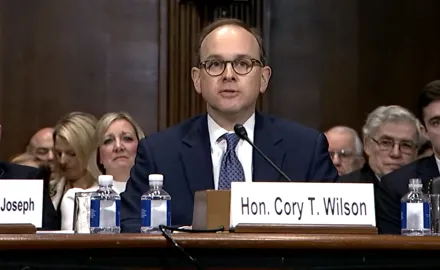
“Confirmed Judges, Confirmed Fears” is a blog series documenting the harmful impact of President Trump’s judges on Americans’ rights and liberties. It includes judges nominated in both his first and second terms.
What’s at stake in this case
A group of parents challenged a policy of the Olentangy School District (OSD) in Ohio aimed at preventing bullying and harassment of transgender students by prohibiting other students from repeatedly mis-gendering them.
What happened in this case?
A right-wing parents’ group, Defending Education (DE), filed a lawsuit, claiming that under the First Amendment, students should be able to repeatedly use pronouns that referred to transgender students’ sex at birth, whether inside or outside the classroom or directed at or about transgender students. A district court ruled against DE and in favor of transgender students and OSD.
DE appealed to the 6th Circuit and a panel ruled 2-1 to affirm the decision below. The full 6th Circuit, however, vacated he ruling and set the case for rehearing before the full court. The November 2025 ruling was in Defending Education v. Olentangy School Dist.
What did the Trump judges and the Sixth Circuit majority decide?
Trump judge Eric Murphy wrote a decision, joined by the other five Trump judges on the Sixth Circuit (Thapar, Bush, Larsen, Nalbandian, and Readler) plus three others, to form a 9-7 majority that reversed the decision below and found in favor of DE. Using slightly different rationales, they all agreed that OSD students had a first amendment right to use pronouns describing transgender students according to their sex at birth, even if it was considered harassing or bullying by some.
What did Judge Stranch and the other 6 judges in the minority say in dissent?
Judge Jane Stranch, who was nominated by President Obama, strongly dissented, joined by the 6th Circuit’s other six judges. She noted that “for over a decade,” OSD’s anti-harassment policies, including with respect to gender identity, “functioned without issue” until DE challenged them. She carefully explained how past precedent by both the Sixth Circuit and the Supreme Court supported the OSD policies against harassment. She also explained that the record in the case led “inexorably” to the conclusion that the “dehumanizing and humiliating effects of non-preferred pronouns” on transgender students could “create a substantial disruption to the educational process,” further justifying OSD’s policies. Judge Stranch was also critical of the majority’s claim that the more the speech at issue resembles “political” expression, the more evidence the school district must present, an approach that she explained contradicted precedent. She concluded that OSD should have prevailed.
Why is the result harmful?
The full Sixth Circuit ruling made possible by its Trump judges will harm transgender students in OSD and likely in other school districts at least in the Sixth Circuit, which includes Ohio, Michigan, Tennessee, and Kentucky. The decision also illustrates the importance of our federal courts to health, welfare and justice and the significance of having fair-minded judges on the federal bench.