“Confirmed Judges, Confirmed Fears” is a blog series documenting the harmful impact of President Trump’s judges on Americans’ rights and liberties. It includes judges nominated in both his first and second terms.
What’s at stake in this case?
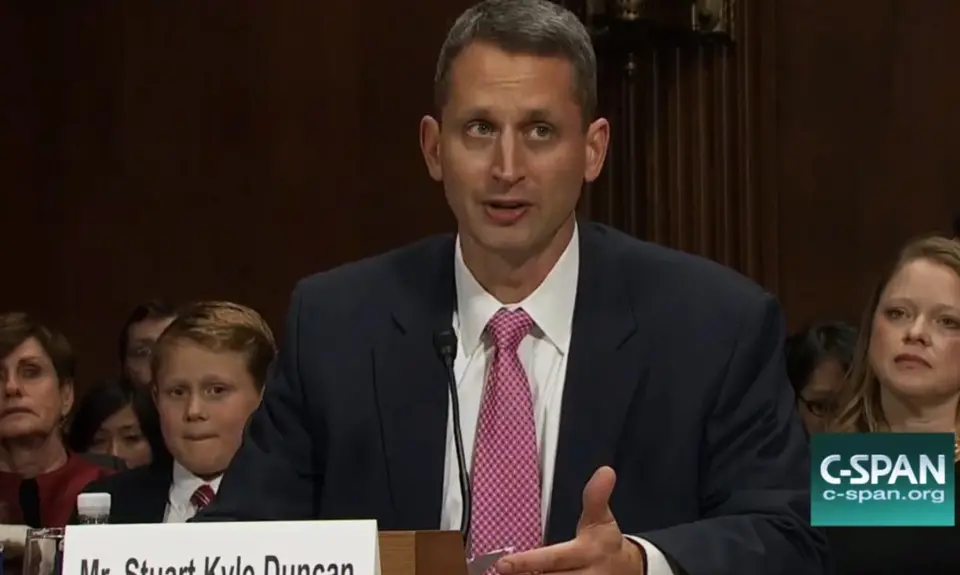
A group of parents challenged a Texas law forcing public schools to prominently display the Ten Commandments in every classroom. With the support of every other Trump judge on the Fifth Circuit, Kyle Duncan wrote a 9-8 opinion upholding the law. The April 2026 case is Nathan v. Alamo Heights Independent School District.
What happened in this case?
In 2025, Texas passed a law requiring that the Ten Commandments be prominently displayed in all public school classrooms. This was in defiance of a 1980 Supreme Court ruling in a case called Stone v. Graham that struck down a nearly identical law in Kentucky. The Supreme Court made clear that requiring the Ten Commandments to be displayed in public school classrooms violates the First Amendment’s Establishment Clause.
Rabbi Mara Nathan and other parents sued to protect the constitutional rights of themselves and their children. A federal district court issued an injunction against enforcing the law because it likely violated both the Establishment Clause and the Free Exercise Clause. Texas appealed to the Fifth Circuit.
Louisiana had adopted a similar law that had also been enjoined by a district court. In February, the Fifth Circuit ordered the Louisiana case dismissed for procedural reasons. It has now decided the Texas case in a 9-8 opinion written by Trump Judge Kyle Duncan.
How did Judge Duncan and the other Trump judges rule?
Duncan wrote an opinion joined by the other five Trump judges on the circuit – Don Willett, James Ho, Kurt Engelhardt, Andrew Oldham, and Cory Wilson – as well as three judges nominated by Ronald Reagan and George W. Bush.
Duncan first addressed the Establishment Clause. He wrote that the Supreme Court’s 1980 ruling in Stone v. Graham is no longer binding precedent because it relied on a previous Supreme Court case called Lemon v. Kurtzman that the current far-right majority has recently repudiated. Therefore, he concluded, laws no longer need to have a secular purpose in order to comply with the Establishment Clause.
Instead, Duncan wrote, the relevant question is whether the Texas law resembles an establishment of religion as the phrase was supposedly understood at the time of the nation’s founding. In other words, he held that the Establishment Clause only prevents the adoption of an official state religion such as occurred in the original colonies before the Revolution and in some of the states until the 1830s. (The Establishment Clause didn’t apply to the states until the adoption of the Fourteenth Amendment after the Civil War.)
Duncan concluded that the Texas law is “nothing like a historical religious establishment” because it does not tell religious institutions what to believe or how to worship, does not limit who they can hire as clergy, does not punish people who do not share certain religious beliefs, does not levy taxes to support the payment of clergy, and does not co-opt churches to perform civil functions.
Duncan also rejected the idea that the Texas law is religiously coercive to students, because it doesn’t direct teachers to proselytize or punish students who disagree with the Ten Commandments.
He also rejected the parents’argument that the law violates the Free Exercise Clause, because it does not require any actual religious instruction. Therefore, he concluded, no child is required to say or do anything that would contradict their or their parents’ religious beliefs.
What did the dissenting judges say?
The eight judges who dissented were nominated by a bipartisan set of presidents: Clinton, George W. Bush, Obama, and Biden.
Biden Judge Irma Carrillo Ramirez wrote the lead dissent. She wrote that while the Supreme Court may have repudiated elements of Lemon, it has not overturned Stone, so it remains binding. As recently as 2022, in the same Supreme Court case where the majority criticized Lemon, they also cited as good law cases raising the same concerns as Stone regarding impermissible state-led religious indoctrination of children. She also explained how, contrary to the majority’s characterization, the Texas law is in fact “problematically coercive.”
Ramirez also wrote that the law violated the parents’ rights under the Free Exercise Clause. The mandated display is clearly religious, its contents are instructive, and it is even labelled “commandments.” Even if it is not made part of the curriculum, it risks undermining parental decisions on their children’s religious upbringing without any compelling state interest.
Why is the result harmful?
The Fifth Circuit’s ruling lets Christian nationalist politicians establish religious orthodoxy and force it upon unwilling children in public schools in Louisiana, Texas, and Mississippi. It also opens the door to other major breaches in the wall of separation between church and state.
More generally, the ruling shows the importance of having fair-minded judges to protect our rights and freedoms.