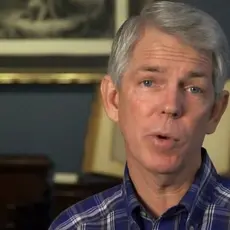
When President Donald Trump announced last week that his administration would be reviewing Smithsonian Institution exhibits because he was upset that "everything discussed is how horrible our Country is, how bad Slavery was, and how unaccomplished the downtrodden have been," the development seemed like precisely the sort of thing that would happen if a Christian nationalist pseudo-historian David Barton had been involved in the decision-making process.
And it seems like that is exactly what happened, as Barton reported during an episode of his "The WallBuilders Show" that he recently told administration officials that "the tone" of the National Museum of African American History and Culture and the National Museum of the American Indian must change because they are too anti-white.
"I was in DC last week, working on the 250th [anniversary celebration]," Barton said. "And while there I was meeting with some of the higher officials in the Interior Department, and they're the ones that over all of the national parks, all of the museums. ... I told them that what I thought was the worst museum in the Smithsonian system was the Museum of African American History because it is so biased in one direction that there is no chance you come out of there with an accurate historical view on the early years, the early centuries of American history."
"I think probably the second most biased museum there is Museum of Native American history, because it, again, is the oppression of the whites," Barton continued. "Time out, before any allegedly white person landed here—if you want to call [Christopher] Columbus white; I don't want he's Anglo or not, but let's say he's the Anglo that they hate so much—you already have American anthropologists and archaeologists that have shown between 20 and 40 percent of Native Americans were enslaved by other Native American tribes before any white guy, white person sit foot here. And then you also have the Comanches, and the Comanches spent more time fighting other tribes than they ever spent fighting Anglos, and the same with the Apaches and the same with the Navajos. The Navajos had a 240-year war against other tribes; that does not come out in those museums. It's all about, 'Hey, this is oppressed people and it's only white people that are capable of oppressing others,' and that tone is what has to go out of Smithsonians."
Barton, who has made multiple visits to the White House for meetings with administration officials and with Trump himself, is highly-influential among religious-right activists and elected officials who blithely ignore his well-documented history of spreading baseless Christian nationalist myths and bigotry.
For Barton to target the African American and Native American history museums is not an accident, given Barton's own teaching on these issues.
For instance, here is how Barton teaches Native American history:
Barton said that Native Americans declared war on "all the white guys" because missionaries tried to convince them to stop torturing their enemies but they resisted these efforts to civilize them and "so we had to go in and we had to destroy Indian tribes all over until" they got the message.
Barton followed that up by defending the practice of wiping out the buffalo on the western plains because it decimated the livelihoods of Native Americans and thereby brought an end to their resistance to the US government.
Barton's teachings on African American history follows a similar pattern, as he blames slavery on "progressives" and once released a DVD called “Setting the Record Straight: American History in Black & White" that, as Right Wing Watch reported in 2006, was nothing but "a 90-minute effort to portray the Democratic Party as responsible for every problem that has ever plagued the African American community in America and imply that the Republican Party is the antidote."
"Throughout the program, Barton presents a staggeringly slanted, openly partisan, and tellingly incomplete view of American history. Barton focuses on the Democratic Party’s historical support for slavery and Jim Crow, but completely ignores the transformation of American politics brought about by the civil rights movement. Barton, of course, never mentions that the rise of the modern Republican Party was built on a “southern strategy” of embracing and exploiting the resentments of racist southern Democrats who joined the Republican Party after Democratic President Lyndon Baines Johnson pushed and signed landmark civil rights and voting rights legislation."
The most telling aspect of Barton's presentation was the fact that it "conveniently [stopped] ... with the passage of the 1964 Civil Rights Act.
Barton primarily credits “strong support of Republicans” for passage of the 1964 Civil Rights Act and 1965 Voting Rights Act, but then all but ignores the political transformation that has taken place over the last forty years. Having been so eager to recount every historical Democratic disgrace, Barton falls silent when it comes to mentioning the split that emerged within the Democratic Party in the 1960s between the growing number who embraced the civil rights movement and those who continued to oppose it. Barton does not mention that President Johnson risked his career and his party’s future to do the right thing, nor does he mention that racist and segregationist southern Democrats left the party and were welcomed by the national Republican Party as part of its “Southern Strategy” to building power. Nor, of course, does he mention a particularly shameful modern-era example of that strategy – presidential candidate Ronald Reagan launching his 1980 bid for the presidency with a visit to Philadelphia, Mississippi to declare his support for states’ rights – with no mention of the town’s notoriety as the place where civil rights workers were murdered and townspeople jeered federal investigators.
In addition, Barton routinely complains that white people do not get enough credit for ending slavery:
"Blacks were not able to free themselves, whites did," Barton stated. "When you get the 13th Amendment, you know, it was nothing but two-thirds of the House, whites in the House were the only ones voting, two-thirds of the whites in the house, two-thirds of the whites in the Senate and three-fourths of the whites in the states that ratified the 13th Amendment to end slavery. And then you have the 14th Amendment, it was nothing but two-thirds of the whites in the House, two-thirds of the whites in the Senate, three-fourths of the whites [in the states.] And so the notion that it's black against white is not borne out by history, but we have made it that way in the way we portray history."
If this is the sort of "expert" who has been guiding the Trump administration, then Trump's attack recent on the Smithsonian makes a lot more sense.