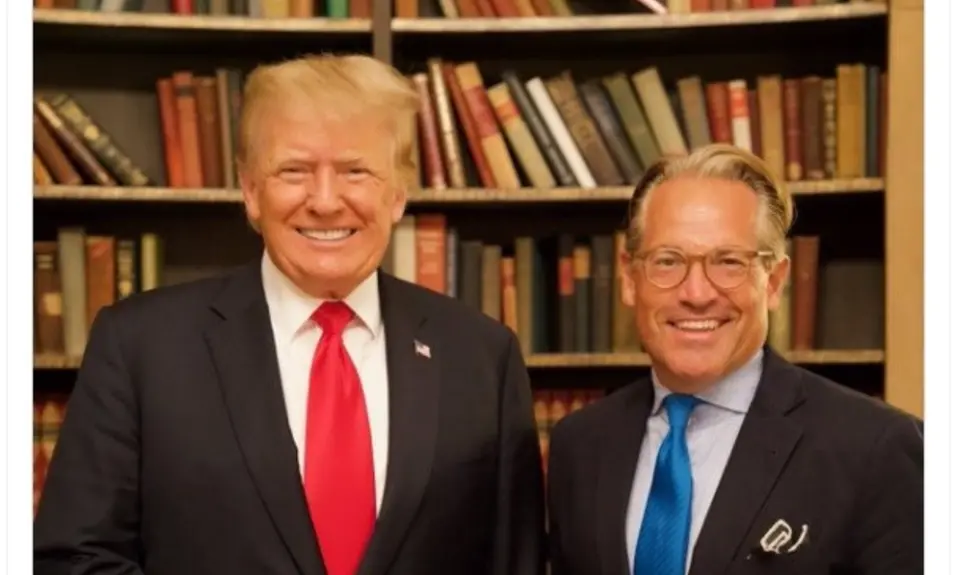
Recently, New York Times columnist Ross Douthat and religious-right broadcaster Eric Metaxas appeared on the "Uncommon Ground" program to discuss the question, "Is Trump the president that Christians need?" What resulted was a fascinating look at what happens when an obsequious Trump cultist like Metaxas steps outside of the MAGA echo chamber and attempts to defend his support for Trump to a skeptic like Douthat.
Over and over again, when pressed to explain why he and other evangelical Christians continue to overwhelmingly support Trump despite his myriad personal and political failings and overtly unchristian behavior, all Metaxas could do was retreat to the argument that Trump is the only thing standing in the way of the "Satanic wickedness of the Democrats."
This was on full display during a lengthy discussion regarding the overtly transactional agreement Trump and his religious-right base made regarding his Supreme Court appointments, in which Trump promised to appoint justices who would overturn Roe v Wade in exchange for their political support.
"If Hillary Clinton, God forbid, had been elected, we would have had three Supreme Court justices in the mold of [Sonia] Sotomayor or, God forbid, [Ketanji Brown] Jackson and the hope of ever overturning Roe v. Wade would have been kicked 100 years into the future," Metaxas said. "So that's the kind of reason people voted for Donald Trump."
"Trump actually said that I'm going to nominate justices who are opposed to [abortion,] actually says the thing that you shouldn't say, and I'm thrilled that he did that," Metaxas continued. "People have often tried to make it sound as though, 'Oh, that's transactional.' Well, that's what politics is: transactional. We the people, we actually govern ourselves. We're not governed by elites. We're not governed by the president. We elect representatives to do our will, to do our bidding and if enough of us believe that they should elect originalist judges, when they do that, that's not really transactional. That's them doing what they were elected to do."
Douthat responded by noting that since the overturn of Roe v. Wade, "Donald Trump doesn't want anything to do with the abortion issue" because it is very unpopular politically and that Trump's position is basically that "religious and social conservatives got what they wanted on this and we're talking about other issues now."
"When Trump pivots and makes it clear that he saw this as a transaction, he delivered his end of the bargain, the deal's done from his point of view, that's the point at which an independent Christian perspective has to be able to say, 'Okay, but we're going to criticize him on that and we're not just going to say, 'Well, be grateful that you got Roe v. Wade overturned,'" Douthat argued.
Douthat then noted the hypocrisy of people like Metaxas claiming that they are willing to be unpopular for standing on ideals and principles to support Trump and his policies but then remain silent when Trump abandons the issues they claim to care about.
"If you're talking about the idea that religious support for Trump is idealistic in the sense that standing up to the Nazis was idealistic, then you have to maintain that idealism and criticize him when he wants to just walk away from the issue," Douthat explained. "If the church takes a political position in support of a politician because of a moral issue and then that politician wants to move on and abandon the issue, then the church can't just be partisan and say, 'Well, we're still on your side.'"
"Well, it depends," Metaxas replied. "I think it's perfectly fair to criticize the president's policy on IVF, on abortifacient drugs. I think that's perfectly fair, but I think it's all a matter of degrees."
"How long does he get a pass for that?" Douthat asked. "Can we get mad at him in the next Republican administration?"
"Get mad at him compared to what? Compared to what Kamala Harris' abortion policy would be?" Metaxas responded. "To me, it's all an issue of degrees."
"But this is what people worry about," Douthat noted. "One moment you're saying we are idealists taking this stance, expecting scorn and opposition but we're doing the right thing and we have to be engaged in politics in this way. But then the person you're supporting seems to be abandoning that cause and you retreat to, 'Oh, well, you know, the other guy's worse.'"
"Well, because it's not the only cause," Metaxas insisted.
"What are the great causes of Trump's second term that you trust him on?" Douthat asked. "I don't think Iran's worked out very well."
"I don't know what I think of the Iran situation," Metaxas flailed. "There's so many other things that are going on. I mean, what happened with the border under Biden is such a scandal. It really does take my breath away. It blows my mind. I cannot imagine that this was allowed and that Trump's pushback on that is characterized as some kind of racism or xenophobia. That's the level that we're at, that we can't even agree with what Obama was saying a few years ago that we ought to have closed borders. I just feel like the Democrats have become so cynical that I don't know what to say anymore."